




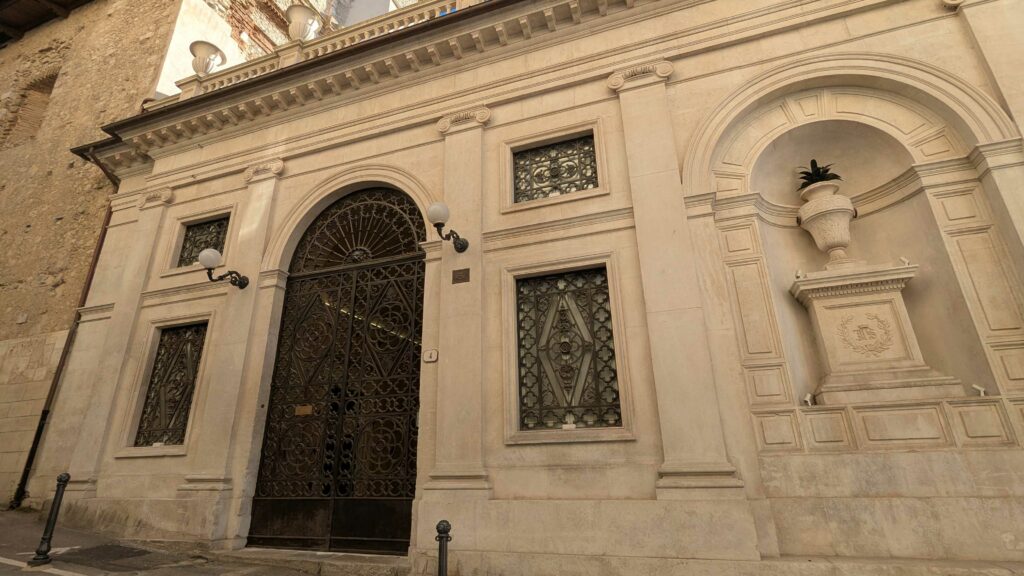
Nel Quarto di San Pietro, il più popoloso dei quattro Quarti in cui si divide la città dell’Aquila, sorge Palazzo Spaventa, con la sua splendida facciata di gusto neoclassico della seconda metà dell’Ottocento.
Prende il nome dai Marchesi Spaventa, antica nobiltà che acquista l’intero isolato nel 1840, e numerosi personaggi illustri si avvicendano nelle file della famiglia traendone grandi vantaggi: in occasione dell’acquisto del Palazzo, per esempio, Giuseppe Maria Spaventa, Ricevitore generale dell’Aquila e membro della nobiltà bolognese, ottiene agevolmente il titolo di Marchese.
Ma l’origine del Palazzo è più antica e di diversa matrice…I principali protagonisti della vita dell’edificio sono i Padri Gesuiti, all’Aquila dal 1596 per volere di Papa Pio IV e artefici della progettazione di un unico complesso (Palazzo Spaventa – Palazzo Camponeschi – Casa Fonticola) unito anche alla Chiesa di Santa Margherita della Forcella (XIII secolo) che costeggia il Palazzo: la struttura medievale, edificata dal Castellum di Forcella – uno dei circa 70 castelli che fondarono la città di Aquila – viene sostituita con un’edificazione barocca, tipica delle fabbriche gesuitiche.
L’Ordine ricopre in città un importante ruolo culturale e politico, nel suo l’Aquilanum Collegium vengono istruiti i giovani nobili della classe dirigente: l’apertura del Collegium è un avvenimento inedito e un’occasione straordinaria per la comunità cittadina, dal momento che “il suo livello può essere considerato di grado universitario” (Ill.mo Prof. Alessandro Clementi).
Alla fine del ‘700, i Gesuiti vengono espulsi dal Regno di Napoli e, dunque, dalla città dell’Aquila e l’intero isolato passa nelle mani prima dei Duchi Costanzo di Paganica, poi dei Marchesi Giannangelo, Nicola e Don Luigi Spaventa che acquistano la proprietà per poco più di 10.000 ducati d’oro.
Del loro breve passaggio gli Spaventa lasciano tracce nell’architettura e nei racconti della nobiltà aquilana dell’epoca: rimandi scultorei alla casata nella facciata del Palazzo, lo stemma familiare con il timbro, la corona al di sopra dell’arme nobiliare che indica il rango a seconda del numero delle punte e…una macabra storia che riecheggia nei cortili e nei ricordi degli aquilani del tempo…
Era il 1864 quando una tragedia avvolse la famiglia Spaventa in un’ombra difficile da dissipare.
Il giovane marchese Giuseppe morì a soli 28 anni: una lapide nella Chiesa capo Quarto di Santa Maria Paganica ne custodisce ancora la memoria. Ma la sua morte lasciò dietro di sé tante domande senza risposta… Veleno, sussurravano le voci. La città accorse, curiosa ed inquieta… il corpo fu deposto in una sala “tutta messa a bruno”. L’accusa più grave colpì il fratello Filippo. Omicidio? Intrighi familiari?
Scagionato! Il padre gli lasciò l’intera eredità ed il Marchese Filippo divenne unico proprietario del Palazzo che passò prima alla moglie e poi alla figlia Francesca: si chiuse così l’irrisolta parentesi aristocratica “noir” e la proprietà tornò nelle mani della Chiesa.
Nel 1926 l’Ordine gesuitico è nuovamente in loco, riacquistando il complesso per ripristinare il Collegio-Convitto e dare avvio ad una nuova intensa attività culturale, fino alla chiusura nel 1967, quando parte del complesso viene ceduto all’Università degli Studi dell’Aquila, ancora oggi centro propulsore di formazione culturale.
Viene realizzato l’ampliamento del Collegio con l’aggiunta della straordinaria Cappella dei Convittori dove l’arte diventa istruzione e il culto si fonde con l’apprendimento, in una sala gremita di studenti su banchi di scuola, di fronte ad un altare, come nelle affascinanti foto in bianco e nero degli anni 50 del ‘900.
La stanza appare come una “monoaula” divisa in tre campate da archi ribassati, su cui poggiano due volte a botte riccamente decorate con giochi prospettici e un soffitto cassettonato che raccoglie molti dei simboli cari all’Ordine gesuitico: il Miracolo eucaristico, la Moltiplicazione del Pane e dei Pesci, la Colomba, il Pellicano che nutre i pulcini e l’Agnus Dei con il libro dei Setti sigilli…una meravigliosa Biblia pauperum ancora oggi dallo straordinario potenziale pedagogico – similmente alla più nota Chiesa gesuitica di Sant’Ignazio di Loyola a Roma, famosa per accogliere file immense di turisti che scattano la foto al soffitto tramite un grande specchio che lo riflette.
La sala è intitolata a Sertorio Caputo, Padre che molto si spese per il Collegio aquilano, elevandolo al livello di studi universitari, e fondatore dell’Accademia dei Velati; chiamato “Angelo della Carità” per la sua dedizione nei confronti del prossimo e dei più sfortunati, morì “in odore di santità”.
E pensare che tanta straordinaria bellezza è stata per decenni nascosta alla vista da uno strato di intonaco, soprammesso presumibilmente negli anni ’80, che copriva interamente le mura.
Nella tragica notte del 6 Aprile 2009, quando il terremoto danneggiò parte dell’edificio, cadde giù anche l’intonaco e il lavoro dei restauratori permise di riportare alla luce il meraviglioso strato pittorico originale.
Oggi è possibile ammirare il Palazzo nella sua interezza e in occasione della nomina della città dell’Aquila a Capitale Italiana della Cultura 2026, la cittadinanza ha l’opportunità di conoscerlo, visitarlo e persino utilizzarlo come luogo di riunioni, convegni e conferenze godendo finalmente appieno di tutta la sua bellezza.
L’Aquila, ancient noir mistery in palazzo Spaventa
In the Quarto of San Pietro, the most populous of the four quarters into which the city of L’Aquila is divided, stands Palazzo Spaventa, with its splendid neoclassical façade dating back to the second half of the nineteenth century.
The palace takes its name from the Spaventa Marquises, an ancient noble family that purchased the entire block in 1840. Many distinguished figures belonged to the family and greatly benefited from their social position: upon the acquisition of the palace, for instance, Giuseppe Maria Spaventa, General Receiver of L’Aquila and member of the Bolognese nobility, easily obtained the title of Marquis.
Yet the origins of the palace are far older and stem from a different background…
The principal protagonists in the history of the building were the Jesuit Fathers, who arrived in L’Aquila in 1596 at the will of Pope Pius IV. They designed a single architectural complex (Palazzo Spaventa – Palazzo Camponeschi – Casa Fonticola), also connected to the Church of Santa Margherita della Forcella (13th century), which runs alongside the palace. The medieval structure, originally built by the Castellum of Forcella — one of the approximately seventy castles that founded the city of Aquila — was replaced by a Baroque construction typical of Jesuit architecture.
The Order played a major cultural and political role in the city. Within the Aquilanum Collegium, young nobles of the ruling class were educated. The opening of the Collegium was an unprecedented event and an extraordinary opportunity for the local community, since “its educational level could be considered equivalent to university studies” (Prof. Alessandro Clementi).
At the end of the eighteenth century, the Jesuits were expelled from the Kingdom of Naples and consequently from the city of L’Aquila. The entire complex then passed first to the Dukes Costanzo of Paganica and later to the Marquises Giannangelo, Nicola and Don Luigi Spaventa, who purchased the property for just over 10,000 gold ducats.
The Spaventa family left traces of their brief presence both in the architecture and in the stories of Aquilan nobility of the time: sculptural references to the family can still be seen on the façade of the palace, together with the family coat of arms, its seal, and the crown above the heraldic emblem indicating noble rank according to the number of points. And then… there is a macabre story that echoed through courtyards and lingered in the memories of the people of L’Aquila…
It was 1864 when tragedy cast a dark shadow over the Spaventa family.
The young Marquis Giuseppe died at only twenty-eight years old. A memorial plaque in the Church of Santa Maria Paganica still preserves his memory. Yet his death left behind countless unanswered questions… Poison, whispered the rumours. The city gathered, curious and unsettled… his body was laid in a room “entirely draped in black.” The gravest accusation fell upon his brother Filippo. Murder? Family intrigue?
Acquitted.
Their father left the entire inheritance to him, and Marquis Filippo became the sole owner of the palace, which later passed to his wife and then to his daughter Francesca. Thus ended the unresolved aristocratic “noir” chapter, and the property eventually returned to the Church.
In 1926, the Jesuit Order returned to the site, repurchasing the complex in order to restore the Boarding College and launch a renewed and intense cultural activity, which continued until 1967, when part of the complex was transferred to the University of L’Aquila, still today an important centre of cultural education and academic life.
The college was expanded with the addition of the extraordinary Chapel of the Boarders, where art became education and worship blended with learning, in a hall once filled with students seated at school desks facing the altar, as shown in fascinating black-and-white photographs from the 1950s.
The room appears as a single large hall divided into three bays by lowered arches supporting two richly decorated barrel vaults with perspective effects, and a coffered ceiling displaying many symbols dear to the Jesuit Order: the Eucharistic Miracle, the Multiplication of the Loaves and Fishes, the Dove, the Pelican feeding its young, and the Agnus Dei with the Book of the Seven Seals… a marvellous Biblia Pauperum that still retains extraordinary pedagogical value today — much like the more famous Jesuit Church of Sant’Ignazio di Loyola in Rome, renowned for attracting long lines of tourists eager to photograph its ceiling through the large mirror reflecting it.
The hall is dedicated to Sertorio Caputo, a Jesuit Father who devoted himself tirelessly to the Aquilan College, elevating it to university-level studies and founding the Accademia dei Velati. Known as the “Angel of Charity” for his dedication to the needy and the less fortunate, he died “in the odour of sanctity.”
And to think that such extraordinary beauty remained hidden from sight for decades beneath a layer of plaster, probably applied during the 1980s, which completely covered the walls.
On the tragic night of April 6th, 2009, when the earthquake damaged part of the building, the plaster also fell away, allowing restorers to bring to light the magnificent original painted decorations.
Today it is finally possible to admire the palace in its entirety and, on the occasion of L’Aquila Italian Capital of Culture 2026, citizens have the opportunity to discover it, visit it, and even use it as a venue for meetings, conferences and cultural events, fully enjoying at last all of its extraordinary beauty.
Location
L'Aquila