





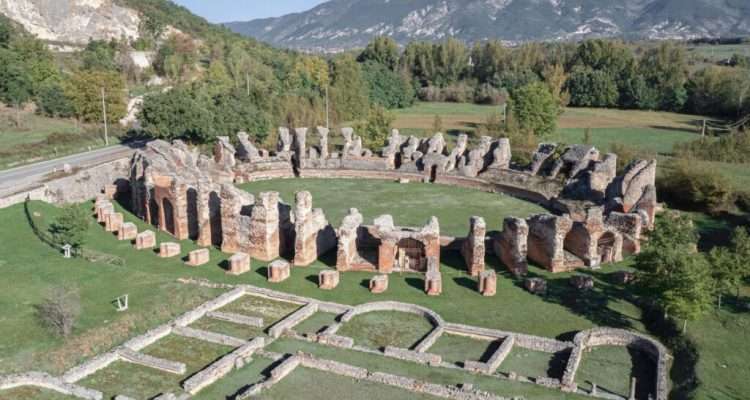
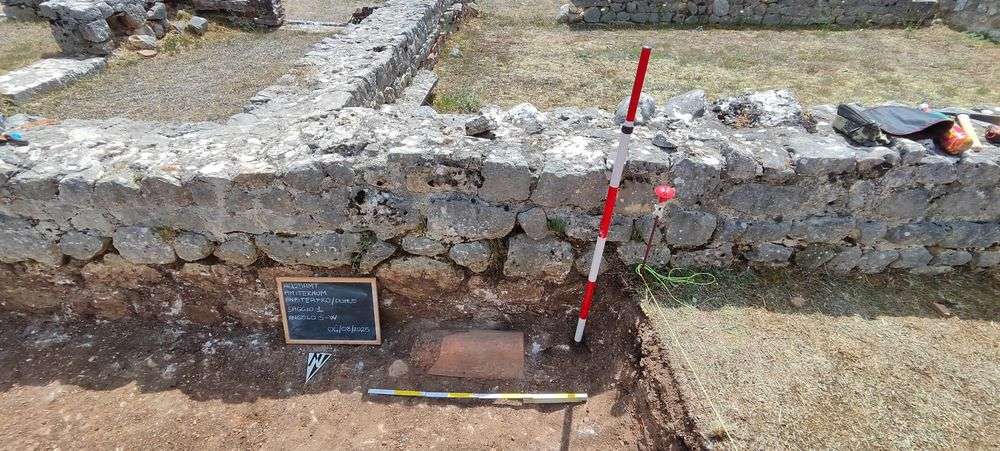
In the summer of 2025, archaeologists from the National Museum of Abruzzo carried out an excavation campaign at the important archaeological site of Amiternum, a Sabine-Roman city located a few kilometers west of the city of L’Aquila, in the Abruzzo region of central Italy.
Amiternum originated with the Italic population of the Sabines. In the 3rd century BC, it was conquered by the Romans and experienced a period of great prosperity, becoming a major urban center for several thousand inhabitants. This is evident from the size of its public entertainment buildings, located on opposite banks of the Aterno River, which runs through and divides the area into two parts. The theater, dating back to the 1st century BC, could accommodate about 3,000 people, while the amphitheater, dating to the 1st century AD, could host around 5,000.
The two excavation trenches focused on a previously unexplored area between the amphitheater and the so-called “peristyle domus,” and are part of a broader project aimed at enhancing the Archaeological Park. This project will also involve collaboration between the National Museum of Abruzzo and the University of L’Aquila, which has been conducting excavations at the site since 2012.
The excavations were funded by the General Directorate of Museums of the Ministry of Culture. In recent months, cleaning, labeling, and cataloguing of the finds have been underway, also thanks to an agreement with the ArcheoClub of L’Aquila, involving the participation of volunteers.
The archaeological investigations brought to light several rooms of the domus, featuring traces of painted plaster and black-and-white mosaic floors, as well as the foundation walls of both the domus and the amphitheater. The findings also made it possible to determine that the domus was built before the amphitheater.
Particularly noteworthy is the discovery of a small child’s burial, protected by a terracotta tile.
In addition to the theater and amphitheater, the city was equipped with a large forum, temples, a bath complex, and several spacious domus residences. Its development was mainly due to its strategic position at the crossroads of important road networks: it lay along the ancient Via Cecilia, which extended to Hatria, and from it branched the Via Claudia Nova and two offshoots of the Via Salaria.
In Late Antiquity, the Roman city underwent both settlement transformations and a process of Christianization. The population moved from the plain to a nearby hill, corresponding to the present-day village of San Vittorino. Here, underground Roman structures were reworked in the 5th century AD by the city’s bishop, Quodvultdeus, of African origin, who renovated and expanded them, creating a Paleochristian mausoleum around the relics of a saint.
Meanwhile, on the plain, the city’s first cathedral, Santa Maria in Civitate, was built. It remained active until the Middle Ages, when the process of founding the city of L’Aquila began, carried out by the so-called “founding castles.”
The diocese of Amiternum was later incorporated into the newly established diocese of L’Aquila.
And the story continues…
Amiternum “regala” i mosaici della Domus
Nell’estate 2025 gli archeologi del MuNDA – Museo Nazionale d’Abruzzo hanno effettuato una campagna di scavi presso l’importante sito archeologico di Amiternum, città sabino-romana situata pochi chilometri a ovest della città dell’Aquila, in Abruzzo, regione dell’Italia Centrale.
Amiternum trova le sue origini con la popolazione italica dei sabini, nel III secolo avanti Cristo viene conquistata dai romani e vive un periodo di grande splendore arrivando ad essere il centro urbano di riferimento di diverse migliaia di abitanti. Lo si può comprendere dalla capienza dei suoi monumenti pubblici dedicati allo spettacolo, situati sulle rive opposte del fiume Aterno che attraversa e divide in due zone l’area. Il teatro, databile al I secolo avanti Cristo, poteva ospitare infatti circa tremila persone, e l’anfiteatro, databile al I secolo dopo Cristo, circa cinquemila.
I due saggi di scavo si sono concentrati in un’area, mai indagata prima, tra l’anfiteatro e la cosiddetta “domus a peristilio”, e rientrano in un più ampio progetto di valorizzazione del Parco archeologico che porterà anche ad una collaborazione del MuNDA con l’Università dell’Aquila che gestisce dal 2012 un altro scavo nello stesso sito.
Gli scavi sono stati effettuati con fondi della Direzione Generale Musei del Ministero della Cultura e in questi mesi sono in corso le operazioni di lavaggio, siglatura e catalogazione dei materiali rinvenuti grazie anche ad un accordo con l’ArcheoClub dell’Aquila che prevede la partecipazione di alcuni volontari.
Gli scavi archeologici hanno consentito di indagare alcuni ambienti della domus, con tracce di intonaco dipinto e pavimenti a mosaico in bianco e nero, i muri di fondazione sia della domus sia dell’anfiteatro. Le indagini hanno anche consentito di stabilire che la domus fu realizzata in un’epoca precedente alla costruzione dell’anfiteatro. Particolare è sicuramente il rinvenimento di una piccola sepoltura infantile protetta da un coppo in terracotta.
Oltre al teatro e all’anfiteatro la città era dotata di un grande foro, di templi, di un impianto termale e di diverse ampie domus. Il suo grande sviluppo fu dovuto principalmente alla posizione strategica al crocevia di due importanti assi viari: era infatti situata lungo l’antica Via Cecilia che arrivava fino ad Hatria, e da essa partivano la Via Claudia Nova e due diramazioni della Via Salaria.
La città romana viene poi investita nella tarda antichità sia da trasformazioni insediative sia dal processo di cristianizzazione. Non si abita più nel pianoro ma sulla collina vicina, l’attuale frazione di San Vittorino. Qui si trovavano degli ambienti ipogei di epoca romana che nel V secolo dopo Cristo il vescovo della città, Quodvultdeus, di origini africane, ristruttura e potenzia realizzando un mausoleo paleocristiano attorno alle spoglie del santo.
Nel pianoro invece viene edificata la prima cattedrale della città, Santa Maria in Civitate, che vivrà fino al Medioevo quando inizierà il processo di costruzione della città dell’Aquila ad opera dei cosiddetti castelli fondatori. La diocesi di Amiternum venne poi accorpata alla nascente diocesi dell’Aquila. E la storia continua…